
The Right to Stoop

The Right to Stoop

The Right to Stoop 

Jesus knew that the Father had put all things under His power, and that he had come from God and was returning to God; so He got up from the meal, took off His outer clothing, and wrapped a towel around His waist.  After that, He poured water into a basin and began to wash His disciples’ feet, drying them with the towel that was wrapped around Him. He came to Simon Peter, who said to Him, “Lord, are you going to wash my feet?” (John 13:3-6).

It’s no secret, I love shoes! My three favorite letters in the English language are D-S-W (as in Designer Shoe Warehouse). Few things are as practical as a pair of shoes. They can dress up a pair of jeans or help you run a race, but they also hide your feet. Feet can be ugly and unattractive. I can prove this in three sentences:

We spend thousands of dollars decorating them (the average pedicure costs $32.25 and the average woman spends over a thousand dollars a year making their ten little piggies look pretty).
We think nothing of nibbling on the toes of our babies, but try this with your teenager (Gross!!!!); and
In some cultures, great care must be taken to avoid showing the bottom of your feet to others, as it can be taken as an insult.

Even in Jiu-Jitsu, where we always have bare feet, we do everything in our power to prevent our opponent from putting their feet on us. We have a warm-up called “dirty feet” where the guy on the bottom tries to put his “dirty feet” on your clean white uniform. Feet are the lowest part of the body and are often dirty. So, given the low status of the lowest member of your body, it’s interesting that one of Jesus’ last acts before the cross was to get up from the table, take off His outer garment, wrap a towel around His waist and wash feet! Feet!

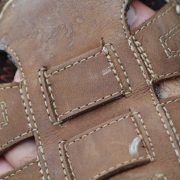
In Jesus’ day, foot washing was the lowest form of servitude. It was left to the lowest servant in the household to stoop down, untie the thongs of the sandal and wash the dust and grime off of people’s digits. It was a demeaning duty in a culture saturated in status and face-saving. There’s even a famous story about the mother of an important Rabbi who wished to wash her son’s feet, but was refused because the chore was too degrading, so she took him to rabbinic court over the right to stoop.  In her mind, it was the ultimate act of honor and love, but in his mind it was an insult to her honor (The Mekhilta of Rabbi Ishmael).

John’s Gospel tells us that Jesus, the God-man, had a big servant’s heart. His act of stooping and washing symbolized the cleansing of our heavy, dirty souls. In fact, the verb for “took off” (lit. “laying down” [tithesin]) in verse 4 is the same verb Jesus used to talk about “laying down” His life for His sheep and friends (10:11, 15, 17-18; 15:13). The greatest lover in the greatest act of love stoops.

The way of Christ is confusing to us. We do power differently; we do status differently; we don’t stoop. In the story, Peter would have none of it, but Jesus’ challenge to Peter stands as a challenge to us:

If we will have none of Jesus’ stooping, then we can none of Jesus (vs. 8); and
If the Master stoops to serve, how much more should His servants? (vv. 12-14).

What is God’s Spirit saying to Me?

The Word of God does the work of God, provided that we become doers of the Word and not just hearers (or readers in this case). One of the best things that you can do after hearing a message or reading a Bible blog is to ask: 1) Lord, what are you saying to me?; and 2) What am I going to do about it?

May I suggest two implications from this passage? First, have you put your trust in Jesus’s stooping? His stooping on the cross cleanses us from our sins and makes us spiritually clean before a righteous and holy God. Only His act of stooping can wash away our sins. Secondly, you have the right to stoop! In fact, if you want to experience a blessing today, find someone to serve. Men, serve your wives. Instead of picking up the remote when you get home, pick up a broom or wash a dish. Students, serve your little brother or sister. I know, I know, you’re older than them, but if the God-man stoops to serve, how much more should you? Lastly, some of us find our identity and joy in serving others, it might even come easy to us. My challenge to you is to let yourself be served. Humbling yourself to receive help can serve as a reminder that rescue must come from outside of us, from the One who “made Himself nothing…and humbled Himself and became obedient to death—even death on a cross” (Phil. 2:7-8).

Settling in

“Leaving Nazareth, [Jesus] went and lived in Capernaum, which was by the lake area of Zebulun and Naphtali—to fulfill what was said through the prophet Isaiah:

‘Land of Zebulun and land of Naphtali, the way to the sea, along the
Jordan,Galilee of the Gentiles—the people living in darkness have seen a great
light; on those living in the land of the shadow of death a light has dawned’”
(Matthew 4:13-16).

Moving stinks! I can see why people tend to stay settled in one place. As Renal and I prepare to move to Louisville, I am up to my neck in boxes, phone calls to utility companies and rental trucks. People keep asking me if I am excited about the move. Excited about moving? No, I’m not, but I am excited about the ministry that will happen after the move. Sometimes a change in ministry requires a change in location.

Jesus moved, did you know that? One small phrase jumps out at me as we relocate from Illinois to Louisville: He went and lived in Capernaum. “Lived” is a small word and not even the main point in the passage, but it looms large for me. The word lived has the sense of taking up a residence and settling in. It makes me wonder what was involved in Jesus’ move from Nazareth to Capernaum:

  • Did He have to move Mary and his kid brothers and sisters with Him? (see Matt. 13:55-56);
  • What kind of house did He settle into? Was it a “fixer-upper”? (At least He had mad carpentry skills);
  • Did He know anyone in Capernaum or did He need to build new relationships?

I don’t know, because it’s not the main point of the passage. Yet, as I reflect on making disciples and launching a new ministry in Louisville, I keep coming back to the question: How did Jesus do it?

If I am to follow in the footsteps of the Master, the first thing that we will need to do is settle. I’ll be looking for new coffee shops to hang out in (this is my 3rd space) and a new Jiu-Jitsu academy to choke people in as we settle into a dog-friendly apartment complex. Since Jesus’ approach to ministry was relational, we’ll be relational and invite people into our homes. Did you know that Jesus had people over into His home?  It’s true, just read John 1:38-39.

Stay Tuned for more updates and keep us in prayer:

  • Please pray that God will move Renal’s start date up at work;
  • Please pray that God would provide a smooth closing for our home in Illinois;
  • Please pray that God would show where He is already at work in the lives of the people we meet so that we can make disciples.